Materials & surfaces
Pickleball Court Surface Materials, Compared
Concrete, asphalt, modular tile, or acrylic resurfacing: each option trades upfront cost against long-term durability differently. Here's what each one actually costs and how long it actually lasts.
Last updated September 23, 2026
Cost, Lifespan & Maintenance by Surface
| Surface | Installed cost | Lifespan | Maintenance |
|---|---|---|---|
| Standard concrete | $5 – $10 / sq ft ($9,000–$18,000 per court) | 20–25 years | Reseal every 2–3 years |
| Post-tension concrete | $10 – $14 / sq ft ($18,000–$25,000 per court) | 30+ years | Minimal, best crack resistance, especially in freeze-thaw climates |
| Asphalt | $3 – $7 / sq ft ($5,400–$12,600 per court) | 8–10 years before resurfacing | Full resurfacing every 8–10 years |
| Modular interlocking tile | $4 – $10 / sq ft (installs over an existing slab) | Individual tiles replaced as needed | Spot-replace damaged tiles; no resurfacing labor |
| Acrylic surface coating | $0.50 – $4 / sq ft ($2,000–$5,000 total finish coat) | 5–8 years | Resurface every 5–8 years ($3,000–$6,000) |
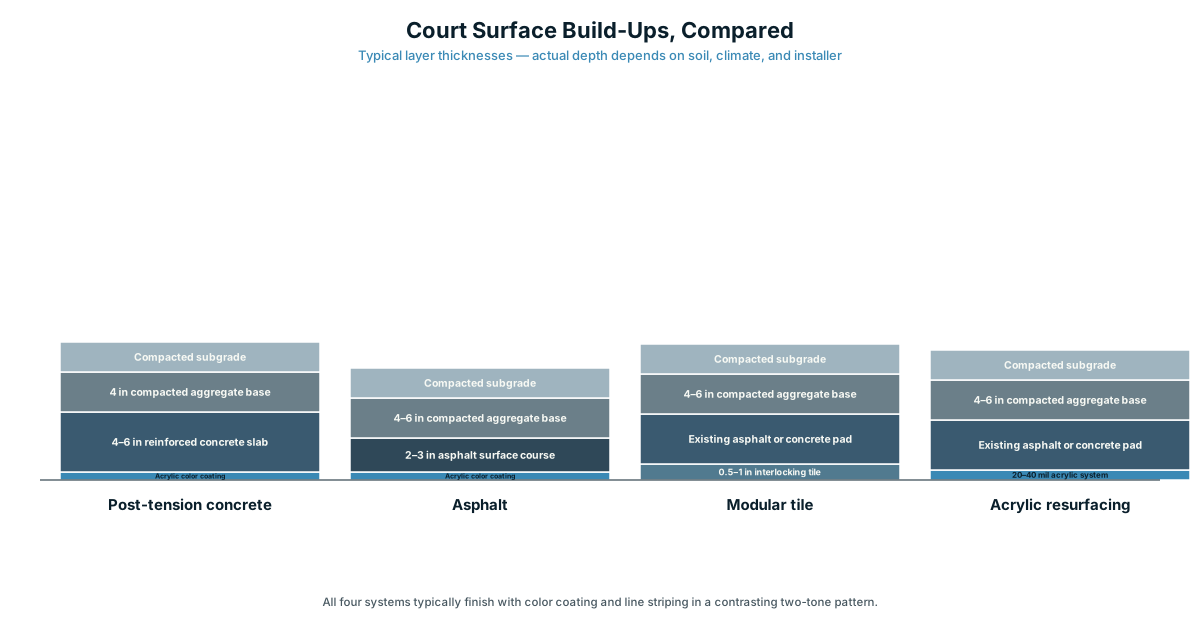
Acrylic coating is the finish layer applied on top of a concrete or asphalt base. It's not a standalone structural surface, which is why it's priced and replaced on its own cycle.
Where to Find These Materials
Current options and pricing change often, so these links go to live Amazon listings rather than one fixed product.
- Modular interlocking sport court tiles : Fastest way to convert an existing pad, no demolition
- Outdoor acrylic court paint kit : Standard color-coating system
- Cushioned acrylic court coating : Softer underfoot for longer play sessions
- Concrete crack filler / patch : For prepping a slab before resurfacing
- Line-striping tape : For crisp two-tone line painting
Some links below are affiliate links (Amazon). If you buy something after clicking one, we may earn a small commission at no extra cost to you. See our Privacy Policy for details.
Concrete: The Long-Term Play
Standard concrete runs $5–$10 per square foot and holds up for 20–25 years with periodic resealing. Post-tension concrete, reinforced with steel cables that keep the slab in compression, costs more ($10–$14 per square foot) but resists the cracking that eventually catches up to standard slabs, especially anywhere that sees real freeze-thaw cycles. If you're building once and want to more or less forget about the base for three decades, post-tension concrete is the option worth the premium.
Asphalt: Lower Upfront, Shorter Cycle
Asphalt costs roughly 30–40% less than standard concrete to install ($3–$7 per square foot) and plays perfectly well when it's properly compacted and coated. The trade-off shows up on the back end: asphalt typically needs full resurfacing every 8–10 years, versus decades for concrete. For a lot of backyard builders, that trade-off still makes sense: you get a playable court sooner and cheaper, and resurfacing a home court is a far smaller job than the original install.
Modular Tile: Fastest Path to Playing
If you already have a concrete or asphalt pad (a driveway, an old basketball court, an underused tennis court), modular interlocking tiles let you skip the base construction entirely. At $4–$10 per square foot installed only over the existing surface, tile is often the cheapest total-cost option for a conversion project, and individual tiles can be popped out and replaced if one gets damaged rather than resurfacing the whole court. The trade-off is feel: tile plays slightly differently underfoot and changes ball bounce compared to painted acrylic-on-concrete, which competitive players sometimes notice.
Acrylic Resurfacing: The Finish Layer, Not the Base
Acrylic coating systems are what actually give a court its color, line markings, and grip, and they sit on top of concrete or asphalt rather than replacing it. A standard acrylic coat runs $2,000–$5,000 for a full court; adding a cushioned system (extra give underfoot, easier on the knees over a long session) adds another $1,500–$3,000. Regardless of what's underneath, plan to recoat every 5–8 years as the surface wears and the color fades from UV exposure. Budget $3,000–$6,000 when that day comes.
Site Prep Matters More Than the Surface You Pick
Whichever surface you choose, the base underneath it does most of the work. A 4–6 inch layer of properly compacted aggregate base is standard under both concrete and asphalt, and skimping here is the single most common cause of premature cracking regardless of which surface material sits on top. Drainage matters just as much as compaction: courts should be graded with a slight slope (typically around 1% from side to side, never end to end where it would affect play) so water sheets off instead of pooling. A court built on unstable or poorly drained soil will develop problems within a couple of seasons no matter how good the surface coating is, which is why a soil and drainage assessment is worth doing before you commit to a material.
Color, Line Painting & Two-Tone Systems
Nearly every acrylic-coated court, concrete or asphalt, finishes with a two-tone color system: one color inside the playing lines and a contrasting color for the out-of-bounds surround, which makes lines far easier to call accurately during fast play. Court striping itself typically runs $200–$1,000 as part of the overall coating job. Beyond aesthetics, color choice affects surface temperature and glare: lighter colors stay cooler underfoot in hot climates, while darker tones show less dirt but can get noticeably hot to the touch in direct summer sun.
Climate Should Drive Your Material Choice
If you live somewhere with real winters, freeze-thaw cycling is the single biggest threat to a court's lifespan. Water gets into tiny cracks, freezes, expands, and widens them, and the cycle repeats every winter until a small crack becomes a structural problem. That's exactly the scenario post-tension concrete is built to resist, which is why it's the common recommendation for cold-climate builds despite the higher upfront cost. In warmer, drier climates without freeze-thaw risk, standard concrete or asphalt perform reliably for their full expected lifespan, and the cost savings are harder to argue against.
Cushioned vs. Standard Acrylic: Is the Upgrade Worth It?
A cushioned acrylic system adds a rubberized layer beneath the standard acrylic coating, which softens impact on knees, ankles, and hips during long sessions. The difference is noticeable if you're playing multiple hours at a stretch or if anyone using the court has joint concerns. It adds roughly $1,500–$3,000 to a standard coating job and typically bumps the per-square-foot cost from the $0.50–$1.00 range up to $2–$4. The downside beyond cost is a very slightly slower ball response, which competitive players sometimes notice but casual and family players generally don't. For a backyard court that's mostly recreational, it's a reasonable upgrade; for a court built primarily for serious training, most players stick with standard acrylic for the truer bounce.
One more factor worth weighing: cushioned systems tend to show wear patterns sooner in high-traffic zones like the kitchen line and baseline, since the rubberized layer compresses unevenly with repeated foot traffic. If your court will see heavy daily use, multiple households sharing it, or a small club running regular open play, factor that faster localized wear into your maintenance budget.
Which Surface Should You Choose?
If you're building new and plan to stay in your home for a decade or more, post-tension concrete is the surface that costs the least over time even though it costs the most upfront. If you want to get playing sooner without draining your budget, asphalt with an acrylic coating is the well-tested middle ground that most residential courts actually use. And if you already have a slab (a driveway, an old sport court, a converted tennis court), modular tile gets you playing in a weekend without touching the base at all. See our DIY vs. contractor guide for which of these projects are realistic to tackle yourself, or head to the cost calculator to price out your specific size and surface combination. All of these figures are national averages; see our regional cost guide for how much your local market can move them.