Conversion
Converting a Tennis Court to Pickleball
An underused tennis court is one of the cheapest starting points for pickleball, since the surface already exists. Here's how many courts actually fit, what has to change about the net, and what a real conversion costs, from a weekend tape job to a permanent four-court build-out.
Last updated October 10, 2026
- Courts per tennis court
- Up to 4
- Net height change
- 36in → 34in
- Temporary conversion
- $450 – $2,500
- Permanent, 4 courts
- $3,500 – $30,000+
How Many Pickleball Courts Fit
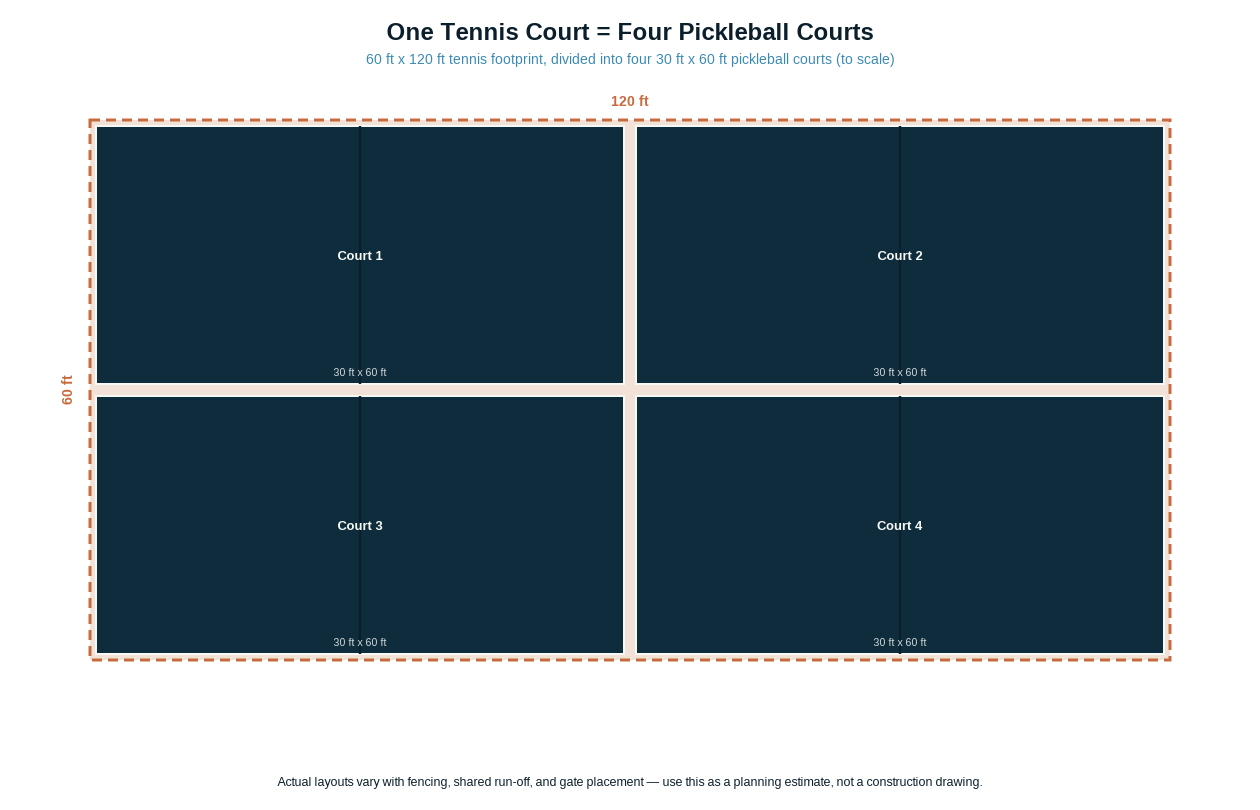
A regulation tennis doubles court, including run-off, measures roughly 60 by 120 feet. A single pickleball court, including the preferred run-off space, needs about 30 by 60 feet. That math is where the "up to four courts" figure comes from:
| Existing surface | Footprint | Pickleball courts that fit |
|---|---|---|
| Tennis doubles court | ~60 ft × 120 ft | Up to 4, striped 2-by-2 |
| Tennis singles court | ~60 ft × 110 ft | Up to 3, depending on run-off |
| Full basketball court | ~50 ft × 94 ft | Up to 2, with tight run-off |
"Up to" is doing real work in that table. A facility willing to shrink run-off space below the preferred 30-by-60 footprint can sometimes squeeze in more; a court with a tight fence line or a net post in an awkward spot might only comfortably fit three. Measure your actual surface before committing to a layout.
Net Height: The One Spec That Always Changes
A tennis net sits higher than a pickleball net, at both the posts and the center:
| Tennis | Pickleball | Difference | |
|---|---|---|---|
| At the posts | 42 in | 36 in | 6 in lower |
| At the center | 36 in | 34 in | 2 in lower |
For a casual, single-court conversion, you don't need to replace the tennis net at all: a net converter strap pulls the center down those 2 inches to the regulation 34-inch pickleball height, and that's close enough for recreational play even though the post height stays tennis-spec.
For a permanent, multi-court conversion, a single tennis net can't serve four separate pickleball courts arranged 2-by-2, so the tennis net and posts typically come out and dedicated pickleball net systems go in at each new court. See our net systems guide for what those cost by type.
Temporary vs. Permanent Conversion
| Temporary | Permanent | |
|---|---|---|
| Lines | Tape or chalk | Acrylic court paint |
| Nets | Portable, or converter strap on the existing tennis net | Dedicated posts per court |
| Cost (4 courts) | $450 – $2,500 | $3,500 – $30,000+ |
| Timeline | A few hours | 3 – 10 days |
| Regulation-compliant | No, casual play only | Yes |
Most backyard and small-facility conversions start temporary. Tape and a portable net let you confirm the layout actually works for your space before spending real money on paint and permanent posts, and tape alone typically holds up for several weeks before it starts peeling at the edges.
The Conversion Process, Step by Step
- 1 Check the surface for cracks, bubbling, or pooling water. Hairline cracks under 1/4 inch can be filled with a polymer crack filler; alligator cracking on asphalt means the surface needs resurfacing before any paint or tape will hold.
- 2 Decide temporary or permanent before you mark anything. A permanent layout needs the full pad to be at least 60 by 120 feet for four courts, so measure first.
- 3 Find the center of the court and measure 22 feet toward each baseline and 10 feet toward each sideline to set the corners of each pickleball court.
- 4 Mark kitchen lines 7 feet from where each net will sit. All lines should be 2 inches wide.
- 5 Install the net: a converter strap on the existing tennis net for a single casual court, or new posts set in concrete footers for a permanent multi-court layout.
- 6 If you're going permanent, remove or cap any tennis net post hardware that falls inside a new pickleball court's play area.
For the full line-painting process, paint types, and official color conventions, see our guide to painting pickleball court lines.
Quick Answers
Can I play pickleball on a tennis court without converting anything?
Yes, casually. The full tennis court is far larger than a pickleball court, so you can set up a portable net within the existing lines and play, you'll just be ignoring the tennis lines rather than playing to pickleball-specific ones.
Is a tennis-to-pickleball conversion cheaper than building a new court?
Usually, yes, since the surface, base, and often the fencing already exist. You're paying for lines and nets rather than excavation and a new slab. Compare against new-build ranges in our cost overview.
Do I need permission to convert a shared or municipal tennis court?
If it's not your own private court, yes; check with whoever manages the facility (an HOA, parks department, or club) before painting permanent lines or removing net hardware. Many communities now manage tennis and pickleball demand on the same courts with scheduled time blocks instead of a permanent conversion.
Where to Find These
Current options and pricing change often, so these links go to live Amazon listings rather than one fixed product.
- Portable pickleball net system : For a casual, single-court conversion with no permanent posts
- Net converter strap : Pulls an existing tennis net down to the 34 in pickleball center height
- Court marking tape : For temporary lines you can pull up at the end of the season
- Acrylic court paint kit : For permanent, regulation-spec lines
Some links below are affiliate links (Amazon). If you buy something after clicking one, we may earn a small commission at no extra cost to you. See our Privacy Policy for details.
Planning the Rest of the Build
See exact dimensions before you mark a single line, or compare surface options if your court needs resurfacing first.